why a monster the motive underneath
The name is not a joke, or not only one. We think it will take monsters to fight monsters, and that people, the rest of life, and the machines we are building will have to work on the same side to face what threatens all of them.
The monsters we mean
Some are old. Power gathers in the middle of things, and the middle attracts the people who should least have it. Some are new. The places where we talk to each other can be flooded with fabricated voices for almost nothing, and a platform paid in engagement has no reason to care whether the engagement comes from people. Fake participation does not wear a network down slowly; it takes it over, like an invasive species. And underneath both is the one that matters most: while attention is spent on manufactured crises, the real ones, in our rivers, forests, soil and climate, go unanswered.
A monster built to fight those would not be one more center. It would be many small hands, holding the same string.
We hand power upward without noticing
Delegation is a human reflex, and usually a sensible one. It is easier to let someone else hold the keys, run the platform, count the votes, keep the money, decide what is true. Each handing-over looks small and reasonable. Nobody adds them up, because what they add up to arrives later, and all at once. By the time the center has been captured, the machinery that was built to run it is available to whoever captured it. Tools built for control will be used for control; the only question is by whom.
Centers attract predators. The bigger the pile of power, money or attention in one place, the more strongly it selects for exactly the people who should not have it.
Walls and better weapons are what we reach for after that earlier failure, when it is already late. The better work happens before: in how we build the places where people meet, decide and trust each other.
A reef, not an empire
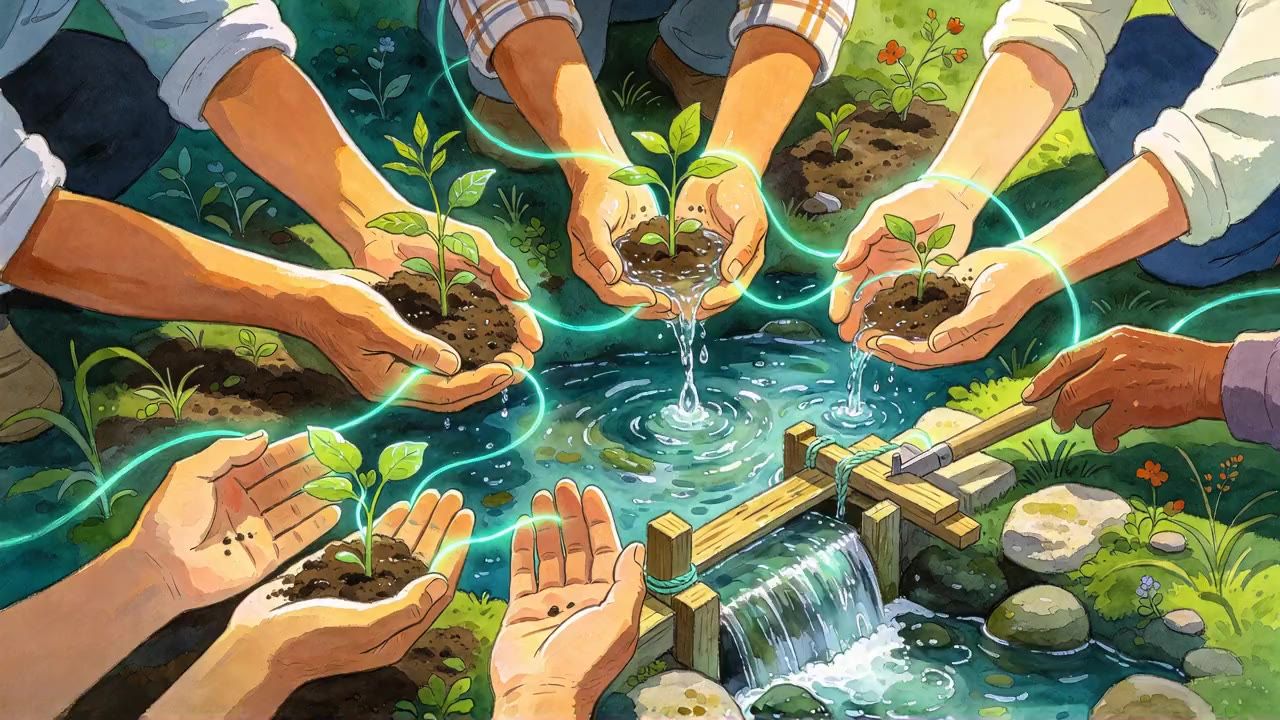
The alternative we keep coming back to is a coral reef: many living things at many scales, competing locally, stable because they are diverse rather than because anything commands them. Oceans do have whales. What matters is that the small creatures have agency too, and know it. If a function is spread across many hands, there is no single point worth corrupting.
That turns into a handful of design rules we try to hold ourselves to:
- Do not deputize trust. Handing enforcement to an authority creates a weapon for whoever holds it. Let everyone decide locally whom they trust, and let those decisions compose.
- Make power legible to people, not people legible to power. Records are public so that anyone can check them, not so that anyone can be watched.
- Fix the rules before the power exists, and rotate power on a schedule, because good intentions are not an enforcement mechanism.
- Assume the founders will not stay good. That includes us. Your key, your record and the right to leave are yours, so this project cannot hold them hostage.
Underneath it all is the ground
We care about captured institutions because captured institutions cannot answer the crises that actually threaten us, and those are ecological before they are anything else. But the concern for watersheds, reefs and forests is not only about their usefulness. The reef has its own claim. A service that maps favourite swimming holes affects the swimming holes, and they cannot file a support ticket. Part of the point of all this machinery is to give people who love such places a way to find each other and act together, and to be believed when they do.
What that means for attest
- Keys, not accounts. What you say is signed with a key you hold. The service that stores it never owns your identity.
- Trust is a path from you. Nobody decides globally what is true. The question is never whether an account is reputable in the abstract, but whether there is a path of trust from you to it, earned slowly and counting for less the further it travels. That is how trust works offline, which is a good hint it is the right shape.
- Communities are organisms. A group has a memory and an immune system no single member has. A group that knows itself can recognise an impostor no classifier could. Thousands of small, sovereign circles are better than one network that encloses a billion people.
- Knowledge is social. A fact in one head is a belief; it becomes knowledge when it is shared, checked and reused. What we are after is consensus reality, with receipts.
- Hold less. Some knowledge is valuable only because not everyone has it: the mushroom patch, the swimming hole, the honest review. The safest secret is one never collected. Where we can, we help people share safely rather than hoard what they share.
What we do not know yet
How well trust graphs hold up against a determined adversary has not been tested at scale, here or anywhere we know of. Whether pseudonymous participation and resistance to trolls can live together is asserted more often than shown. How communities should govern themselves in signed records, admitting members and settling disputes, is open. Recovering a lost key, and rotating power in practice, are unsolved. We would rather say so than pretend. The roadmap lists what we are working on, and the history page shows how many people have worked on these questions before us.
The monster
Our mascot holds a cat's cradle, a shape made of nothing but string and the hands that hold it; take the hands away and there is no shape left at all. If attest is a monster, we mean it to be that sort, public and made of relationships, with too many hands on it for any one of them to walk off with it.
A reading of the founder's longer essays and notes, drafted with Claude and published for his revision.